
How to Grow Pomegranates: Planting, Care, and Harvest Tips
Pomegranates are one of the oldest cultivated fruits, with references dating back to Old Testament times. But they are not just rich in history. Pomegranate trees are beautiful, heat-loving, and productive, especially in warm, arid climates like Arizona.
Pomegranates are one of the easiest fruit trees to grow in the low desert. They thrive in the heat, don’t mind our alkaline soils, and seem made for tough desert conditions. In spring, they’re covered in bright red blooms, followed by golden yellow leaves in the fall. Iif you can keep the leaf-footed bugs away, you’ll get a delicious harvest too. Here are my best tips for growing pomegranates in the low desert.

What This Post Covers
- Is a Pomegranate a Tree or a Bush?
- Which Pomegranate Variety Should I Plant?
- When and How to Plant a Pomegranate Tree
- How to Care for and Prune a Pomegranate Tree
- Why Doesn’t My Pomegranate Tree Have Leaves in Spring?
- Why Are There Flowers But No Fruit?
- How to Tell When a Pomegranate Is Ready to Harvest
- The Best Way to Eat a Pomegranate
- Why Is My Pomegranate Fruit Splitting?
- Why Does My Fruit Look Rotten Inside?
- What Can I Do About Leaf-Footed Bugs?
- Final Tips for Growing Pomegranates

Is a Pomegranate a Tree or a Bush?
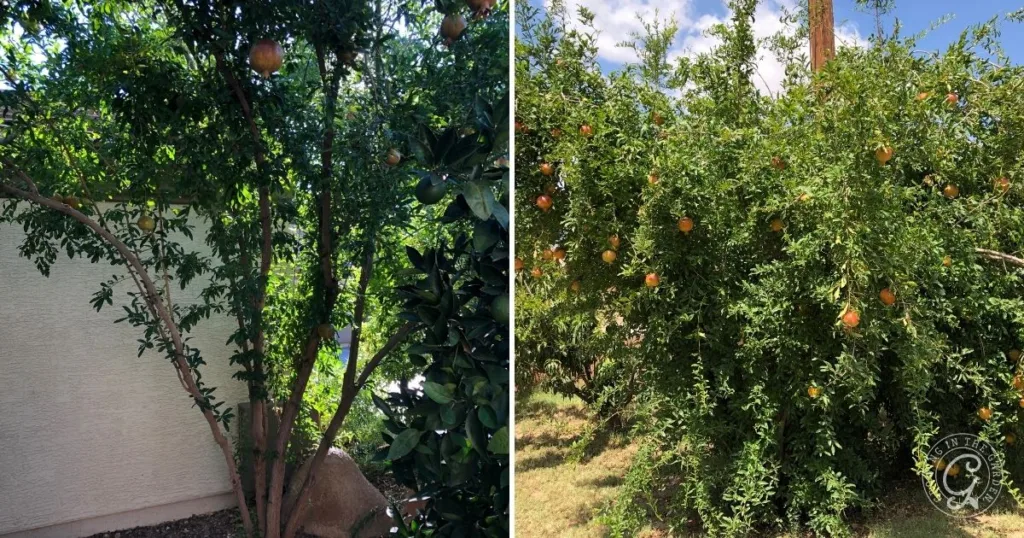
Pomegranates (Punica granatum) are deciduous and typically grown as small trees that reach 12 to 20 feet in height and width. They can also be grown as large bushes by allowing the suckers at the base to grow.
To grow as a tree, remove suckers and train the plant to form a multi-trunked shape. Dwarf varieties are ideal for containers.
Which Pomegranate Variety Should I Plant?
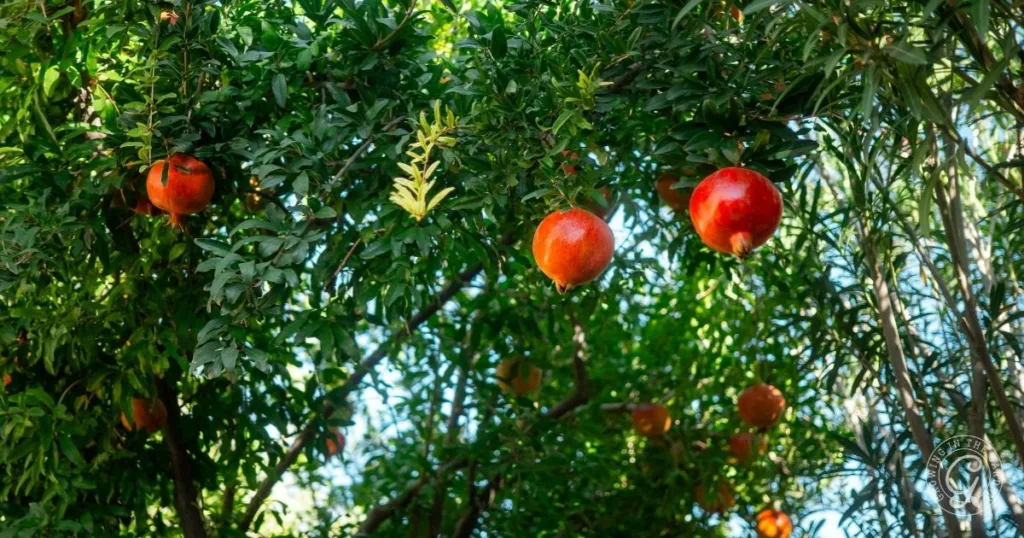
Choose a variety suited to your climate. Some types perform better in cooler zones, while others thrive in heat. These are good options:
- Balegal – Large, pale pink fruit with sweet flesh. Hardy to zone 7
- Crab – Medium to large bronze fruit with tart, rich flavor
- Early Wonderful – Large red fruit with a tart flavor. Very productive
- Granada – Crimson fruit with semi-sweet flavor. Matures early
- Sweet – Medium pink fruit with very sweet flesh. Productive
- Utah Sweet – Soft seeds, pink skin and flowers, sweet flavor
- Wonderful – Large red fruit with tangy-sweet flavor and soft seeds. Thrives in Arizona
For more ideas about what to plant for a continuous harvest, see this guide to year-round fruit tree harvests
When and How to Plant a Pomegranate Tree
In hot climates like Arizona, plant pomegranates in spring or fall.
Planting tips:
- Choose a location with at least 6 hours of direct sunlight
- Pomegranates prefer well-drained soil but tolerate poor or alkaline soil
- Dig a hole twice as wide and as deep as the nursery container
- In colder zones, plant near a south-facing wall or grow in a container that can be moved indoors during winter
How to Care for and Prune a Pomegranate Tree
Once established, pomegranates are low-maintenance. Here are care tips:
- Watering: Water deeply during summer and more often when newly planted
- Fertilizing: Apply compost or an organic fertilizer in February, and 2 to 3 times a year as needed
- Pruning: Not required, but you can prune to control size, remove suckers, or shape the tree. Prune in late winter after leaf drop
- Thinning: Leave one fruit every 6 inches. This helps grow larger fruit and prevents branch damage
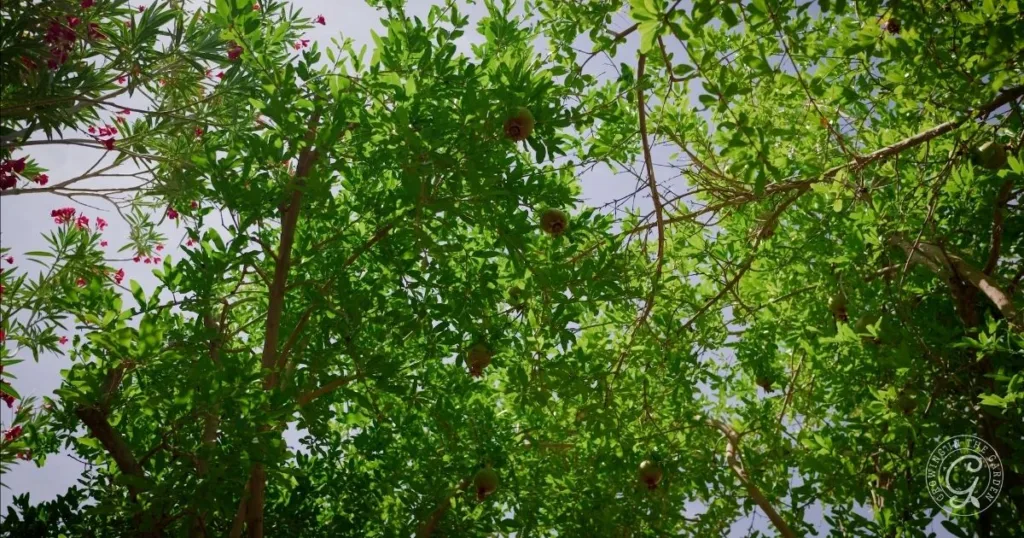
For more guidance on managing fruit trees, see this post about pruning fruit trees
Why Doesn’t My Pomegranate Tree Have Leaves in Spring?
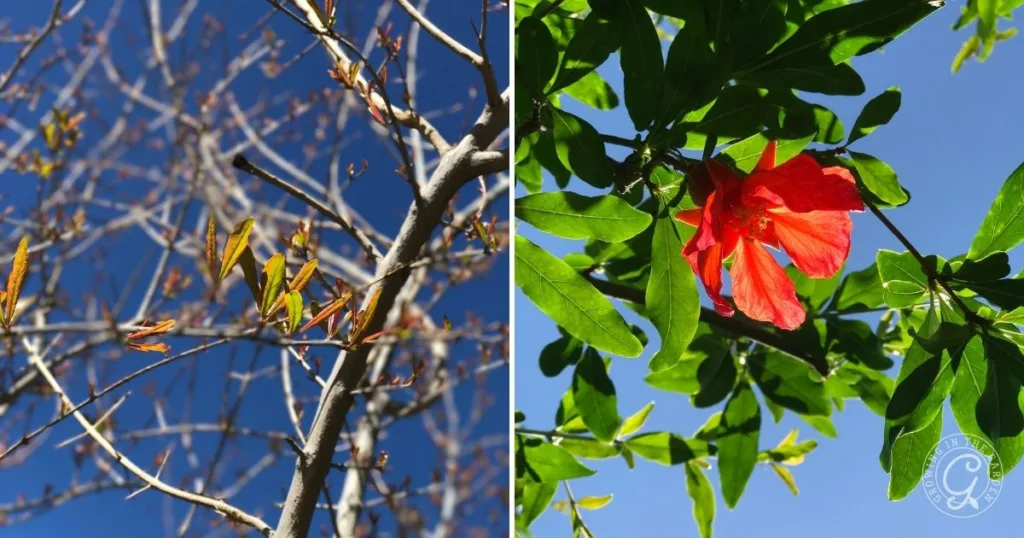
Pomegranates are slow to leaf out in spring. Be patient. If your area experienced temperatures below 10°F, some damage may have occurred. Wait until late spring to determine if any trunks are dead, then prune as needed.
Why Are There Flowers But No Fruit?
Trees younger than three years often bloom without fruiting. For older trees, fruit drop or failure to form can result from:
- Overwatering or poor drainage
- Lack of sunlight
- Excess nitrogen fertilizer
Planting more than one tree, even of the same variety, can improve fruit set. Although pomegranates are self-fruitful, cross-pollination can help.
How to Tell When a Pomegranate Is Ready to Harvest
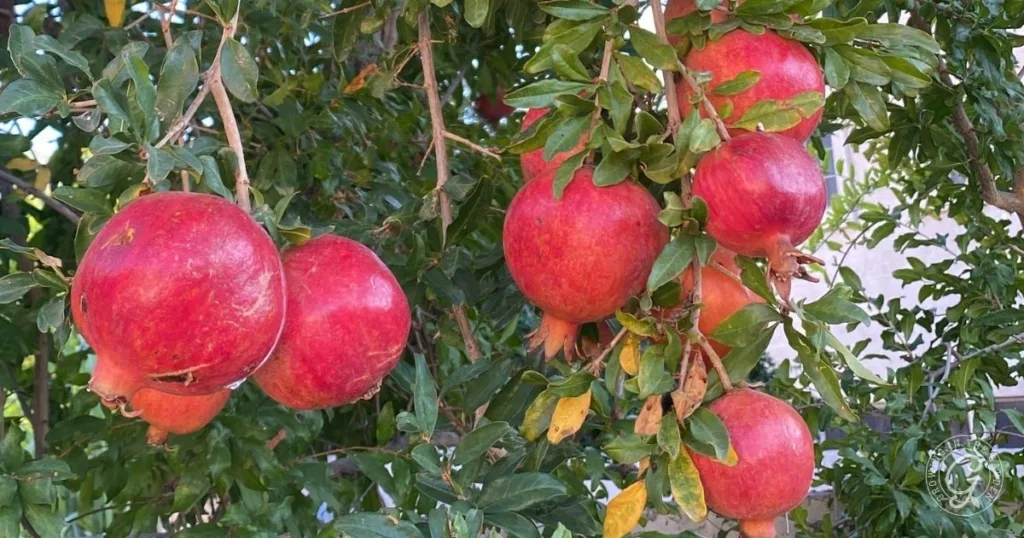
Pomegranates ripen from August to November, depending on the variety. Look for these signs:
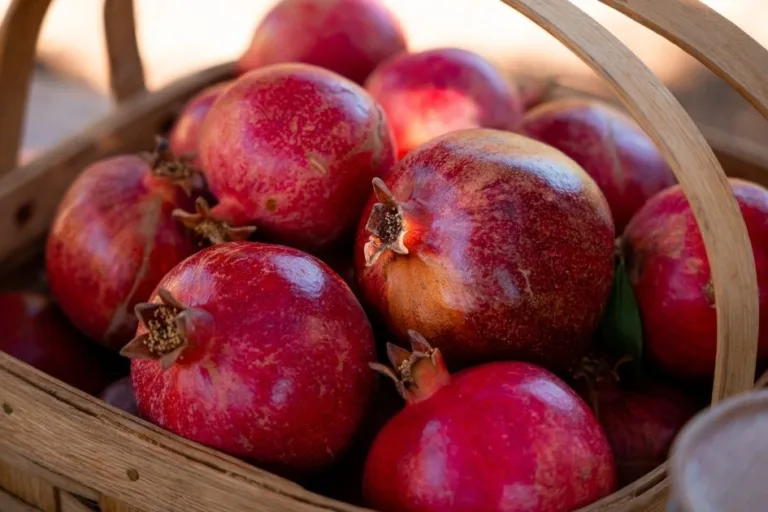
- Skin changes from shiny to matte and deepens in color
- Fruit changes from round to slightly angular as seeds swell
- Stem and blossom ends flatten
- Fruit sounds metallic when tapped
- Ripe fruit twists easily off the branch (though cutting is better)
- If the fruit splits or falls, it is ready to pick
In late fall, you may notice a second, smaller harvest of pomegranates. These fruits are often very sweet but may split open. Keep an eye out and pick them before the birds do, or leave them for the birds to enjoy.
The Best Way to Eat a Pomegranate

To remove seeds easily:
- Cut the top off the pomegranate (the blossom end).
- Score the ridges on the outer skin.
- Hold the fruit over a bowl of water, cut side down.
- Tap the back firmly with a wooden spoon. Seeds will fall out into the water.
- The pith will float to the top of the water, scoop it out and remove it.
- Ripe seeds will fall to the bottom of the bowl. Drain off water and enjoy!
Try this Pomegranate Jalapeño Cream Cheese Dip. It’s a family favorite
Why Is My Pomegranate Fruit Splitting?
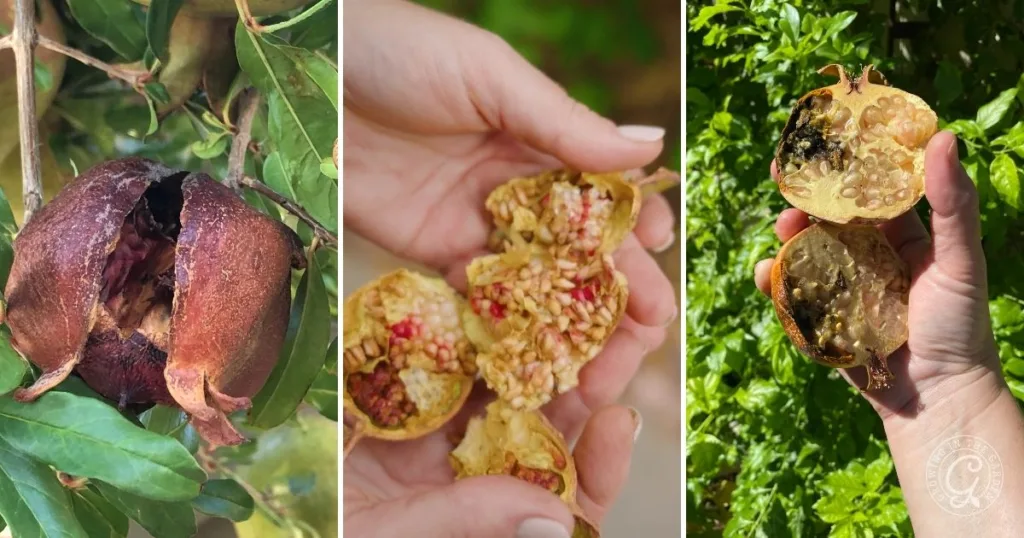
Splitting can happen when:
- Fruit is left on the tree too long
- Soil moisture fluctuates (especially with dry conditions, heavy watering, or rain)
- Nearly-ripe fruit receives a sudden increase in water
Apply mulch and maintain consistent moisture to reduce splitting.
Why Does My Fruit Look Rotten Inside?
Fungal issues like Alternaria or Aspergillus rot often cause this. It can also result from leaf-footed bugs transmitting yeast.
To reduce this problem:
- Avoid overwatering or water stress
- Clean up dropped fruit and dead branches
- Remove cracked or overripe fruit from the tree
What Can I Do About Leaf-Footed Bugs?
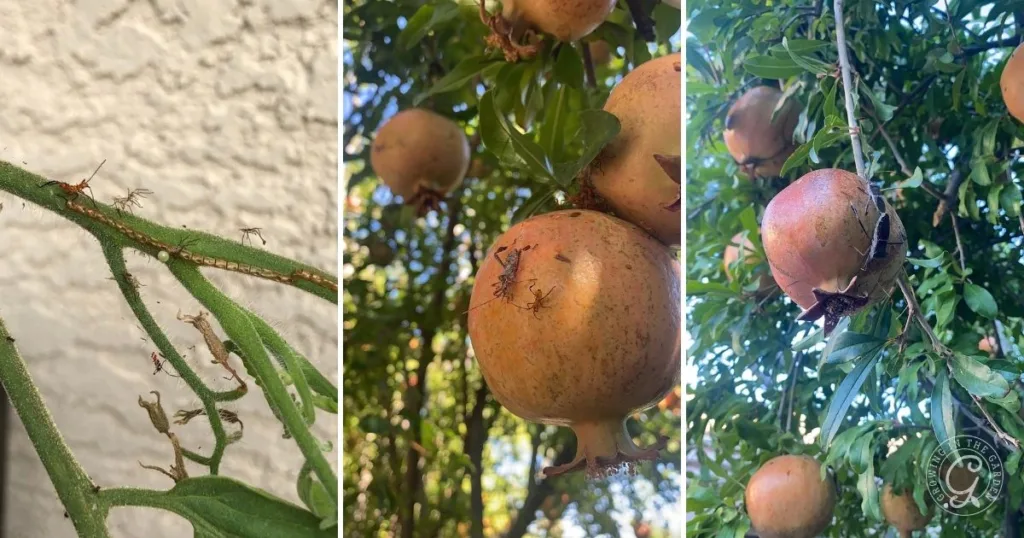
These bugs pierce fruit and feed on the juices, damaging crops. Control them by:
- Learning to identify all life stages (eggs, nymphs, adults)
- Inspecting your tree often, especially in the morning
- Removing bugs by hand and destroying them
- Using insecticidal soap on young nymphs
- Cleaning up overwintering spots such as woodpiles, weeds, or old fruit
Learn more about leaf-footed bugs and organic pest control
Final Tips for Growing Pomegranates
- Plant in full sun with good drainage
- Water deeply and mulch regularly
- Prune after leaf drop for best results
- Thin fruit for larger harvests
- Watch for splitting or rot near harvest time
- Stay ahead of pest problems, especially leaf-footed bugs
For more seasonal guidance, see the Arizona fruit growing calendar and other fruit tree posts
If this post was helpful, please consider sharing it with other gardeners.

I have a pomagranate, not sure if tree or bush or what variety. It is approximately 4yrs old and has 2 small orangish balls low on it and that’s all. Is this normal?
By 4 years old it should have much more fruit on it. I would consider replacing it.
Hello, hope you are doing well!
We are pretty new to Arizona and we have a pomegranate tree in our back yard. Don’t know how to take care of it.
It gets watered everyday in the morning (might be every 2 days, as it’s set on automatic. So I am not 100%, but I believe it’s every day).
I had fertilized it couple of times this year.
First 2 times was nitrogen based fertilizer for helping to bloom.
Then yellow leaves stayed showing up inside the tree.
So I got citrus fertilizer that had other minerals in it and fertilized it at the end of May.
However the tree is struggling even more now.
Not sure if it has anything to do with over 100 degree weather? The tree is mostly in the sun and gets shade in the afternoon.
Do you have any suggestions?
Thank you so much!!
Welcome to Arizona! Pomegranate trees love the heat and grow well in our climate. Sounds like the watering may be part of the problem. Fruit trees – all trees actually benefit from deep water less often. Deep watering less often encourages the roots to go deep and strong. Frequent shallow watering encourages the roots to stay close to the surface, they don’t have to go far to get water. Try to lengthen the amount of time you water, but aim to water no more than once a week in the hottest, driest times of the year, and much less often during the cooler parts of the year. Once every 2 weeks or once a month during the winter (if we get a good drenching rain, then you can skip that watering.) Try to water to a depth of about 3 feet for trees, 2 feet for perennial bushes and shrubs, and 1 foot for annual plants.
During the hottest months of the year, it’s best not to fertilize. Pomegranates are happy with a good covering of compost each year, just as they are leafing out. This adds organic matter to the soil and feeds them as well.
Hope this information helps. Please let me know if you have other questions. Thanks for commenting.
we live in Scottsdale, we brought this plant from my house in California and my plant is doing great, i have so many Pomegranate fruit on the tree, but some of them started to open, they are still small. What can I do?
Elvira Ashmun
Once they split, you probably need to harvest them. Be sure it’s getting enough deep watering. The tree may be adjusting to the higher temps here.
Hello, thank you for all the information about the pomegranate tree. I have a question that I can’t find anywhere online. I live in Surprise, Arizona and I want to plant my pomegranate tree on my western facing fence. Will it survive the afternoon sun and the reflected heat from the wall. Thank you for your time.
Yes. Pomegranates do fine in full sun, even reflected sun. They are a tough plant. Wait to plant until temps cool a bit in the fall and it should be fine.
I have had this pomegranate tree for about 25 years and it has stopped producing. Do they quit producing after a certain amount of time? Is there an age where they stop?
Wow! 25 years, that’s great. I wasn’t sure about the answer to your question. A quick google search seemed to say that although the trees can live for up to 200 years, most of the fruit production occurs in the first 15 or so years. That may be what has happened with your tree.
Pom trivia: Pomegranates were on the Priests robes & all over the Temple,in Jerusalem. EVERY Pom has a 6 STAR of DAVID stem! Every one!
Hello! I pruned my pomegranate tree in the winter in the place we rent. However, I feel like a few years prior no one pruned it, so it’s was a big mess. I removed a lot of big and small branches, but was afraid to over prune it. So I did the best I could.
Now being spring in AZ, the tree just grew so much and have some much bloom, all the branches are down to the ground from the weight. I tried propping the branches up, but it’s barely helping.
Can I still prune some branches away, when it’s blooming? Also, we will have way too many fruit if I won’t do anything about it. The branches won’t be able to handle it.
Looking for suggestions.
Thank you!
You can prune pomegranates at any time. Pomegranates often self-thin, but it sounds like you may have to do some thinning so the branches don’t break. I would wait and see how much fruit actually sets and then thin the fruit to a smaller amount on each branch.
wow amazing
Any suggestions for keeping the critters out of my tree? Last year the pack rats got all our pomegranates.
Keep branches away from houses, fences, etc. I have also seen rat traps https://amzn.to/2Yo0Hek attached to the lower trunks of trees.
how do you prune pomegranate for size? do they bear fruit on new wood or previous year’s wood? As this would determine how to prune right? Don’t want to prune and loose all of next years fruit.
I live in zone 10 Florida . I am wondering if my. Plant will thrive here .
Check with a local nursery to see how they do in your area.
Thanks for this great article! I have three trees and the fruit on two of them have been rotting for the last few years. It seems to me like they are getting sunburned. Is that possible? The rotting shows up on the skin and almost looks like it is melting off. It is also black inside so maybe that is just heart rot. Do you have experience with sunburned fruit?
I’ve had some sunburned fruit as well, especially if it gets damaged a bit by insects or birds and then begins to rot.
Thank you for your article. Sensible and informative. I have, with my partner, purchased 3 hectares of virgin land in Romania. Transylvania province in the central plains south of Cluj. I have many hopes and plans. I would love to plant pomegranates. Now I think I can. The growing season there is getting hotter. I caught the reference to a wall or south facing slope to increase heat. I will work the land to include that. I thank you for the condensed listing of best varieties. I am excited. I will be growing organically and we will be applying to have the land registered for organic growing.
Thanks again.
David
I’m planting a Pink stein Pomegranate in Clovis, CA so I google some information. Fun to see your post come up first. Tell Jeff he married way above his head!
Ha! I’m grateful every day I married him. Best of luck with your tree, and tell Heidi hello!
For the last few years our pomegrante seeds are clear and not red and they are also fairly small. What is wrong?
If that is a change from previous years it may be an issue with watering or insect damage. If the outside of the fruit is brown and mottled that could be a sign of insects.
My tree is 10 years old. I pruned it way down about 3 years ago, this is the first year after that to have blossoms and fruit is starting to show. However just recently a lot of the young fruit fell to the ground, is that normal?
The tree will often drop fruit to self-thin. Hopefully you’ll still have some fruit to enjoy.